Showing posts with label photography. Show all posts

Tuesday, July 1, 2008

:ARTICLE: How to Take Great Fireworks Photos with a Point & Shoot

Getting great fireworks photos has to be hard, right?

Not necessarily. The pros want us to believe this, I think, but scrapbookers and photography hobbyists can still get great results without loads of equipment and studying aspects of aperture, shutter speed, focal length and such for hours before the event or spending the entire show trying to get your settings just right.

All of the photos in this post were taken by me last year with my Canon S3 IS and I'll give you my 5 basic steps to how I got my results.

1) Scope out your location.

Try to arrive on site while it's still light out so that you can make sure that you get a good position for shooting. Try to avoid areas where trees or other obstructions may hinder your shooting. You want to have a clear view of the area of sky where the bursts will appear.

2) Use a tripod.

Okay, so you will need this one other piece of equipment to get good shots. With fireworks, it is an absolute must considering the length of time that your camera's shutter must be open to capture the brilliance of fireworks. The camera must be PERFECTLY still during that entire length of time in order to get a good shot. But it doesn't have to be anything too fancy. The one I use is actually one my husband picked up at an auction for around $5.

3) Use your self-timer.

Articles of this type will generally suggest that you use your remote release to trigger the camera to avoid camera shake when pushing the shutter release. Although some P&S cameras have a remote release option, most do not. The easy way around this is to use the self-timer. My camera has a 2 or 10 second option, so I set mine on 2 seconds and will generally hit the shutter release when I hear or see the firework trajectory leave the ground. It's not full proof. Some fireworks take longer than others to burst, but it works enough of the time to get some great shots.

4) Frame your shot.

Take a variety of shots. Use your zoom to get some shots that will zero in on the burst itself and zoom out to get some that take in some of the scenery as well, such as the shot below where you can see a bit of reflection of the firework on the water. If you're attending a show within a city, you may actually want to include part of the cityscape in your photos to give them a greater sense of place. Also, don't assume that if you don't get the entire burst within your frame that it's one for the recycle bin. Some of my favorite shots are those that only show part of the burst against black sky which actually makes for a very interesting photo in terms of composition.

5) Use the fireworks setting.


Yup. It's allowed. That's why it's there. Camera manufacturers didn't create all those settings so that you could feel guilty about using them. They created them so that more people could enjoy the art of photography! I used the fireworks setting for every picture in this post, so no time was wasted trying to figure out the perfect settings.


PLUS 3 more little tips:


1) Take a flashlight. Always good to have when trying to take photos in the dark.


2) Charge your batteries. You'll be taking lots of shots to get your keepers in this type of shoot. Make sure your camera doesn't die on you half way through the show.


3) Empty your memory card. Again, lots of photos, so you'll want to have as much room available on your memory card as possible.


I hope that these hints and tips are helpful to you as your venture out for fireworks later this week! I would love to hear from you if you have any other fireworks photography hints and tips to share.

Wednesday, June 25, 2008

:PHOTO SHOOT: Field of Yellow

Okay...so maybe they are weeds, but who cares. I still think it made for some cute pictures.


Friday, June 13, 2008

:LIFE: Tell me a story...

Kaitlin has always really enjoyed a good story. She's got a couple shelves worth of hard cover books in her room plus a few baskets full of softcover books.

Even though it doesn't happen every night, I've been reading to her since she was probably about 6 months old and am always on the lookout for unique books.

This book is called Do Princesses Wear Hiking Boots? and it is the cutest story. Every little girl should have a copy.

It's one that I picked up for her while on a business trip a couple of years ago. I was in some middle-of-nowhere town in Nebraska (I think it was Broken Bow) and found this cute little shop with great children's toys and books. Good find...

Lately, she loves to have me read the story and then she'll 'read' the story to me. Sometimes, she gets it pretty darn close to the actual story and sometimes she takes the story along an entirely different path...on purpose...and it is so fun to see where her imagination takes her.

Wednesday, June 11, 2008

:ARTICLE: Get Your Light Right

I have another photography related article published over at WeScrap. It was part of the June newsletter, but you view other great WeScrap articles and tutorials here.

Get Your Light Right

You don’t need to have a studio full of professional lights to get great photos of your loved ones. Many of us simply don’t have the space or budget to set up an indoor photography studio at home. Does that mean we shouldn’t be able to get quality results without have to spend an arm and a leg for a professional? Absolutely not! Over the years, the great outdoors has become my favorite studio. Backdrops are in endless supply and all you need is a few good tips to get some great lighting.

#1 – Get natural: Natural light is actually the most flattering type of light for photos. So get outside and start shooting. Don’t be afraid of weather either. Foggy and rainy days can actually create great mood for more creative shots.

You can also take advantage of natural light indoors. Turn off the indoor lighting and position your subject near a large, bright window or set up a makeshift studio beside your open garage door. Position your subject so that the light hits them from the side and use a reflector opposite the window to bounce even more light onto your subject. The photo below was taken indoors with my daughter lying on the floor several feet to the right of our living room window. I left the sheers closed to soften the light hitting her face, essentially acting as a diffuser.

#2 – Get Shady: While natural light is ideal, direct light is not. Contrary to popular belief, sunny days are not always best for taking photos. Direct light can cast harsh shadows on faces and cause squinting which is never flattering. Cloudy days can actually be better for taking photos. If you can’t avoid a sunny day, look for open shade such as on the side of a tall building (like I did in the shot below) or a lush tree to get better results.

#3 – Get Golden: The hour after sunrise and before sunset are known as the Golden Hours to photographers. These are the absolute BEST times of the day to take photos as the light is generally very soft and warm as a result of the sun being so close to the horizon and therefore causes colors to be at their most vibrant.

#4 – Get Flashy (but not when you think): Flash indoors, no flash outdoors, right? Not necessarily. While using flash indoors is sometimes necessary in low light indoors situations, don’t flip up that flash out of habit. Open the curtains and let there be light. The colors will be more natural and warm. Then, when you can’t avoid direct sunlight outdoors, make sure that the subject’s back is to the sun to help avoid squinting and use your flash. It can actually help to fill in some of those nasty shadows.

Let me know what you think of this article on lighting...basic, I know, but that was the idea. Are there other basic lighting tips that you live by to help improve your natural light photography?

Saturday, June 7, 2008

Photo Shoot: Dancing Dream

A few favorites from a recent shoot...


Saturday, May 31, 2008

Photo Shoot: Grey Wall

A few more from our dowtown photo shoot a few weeks back.

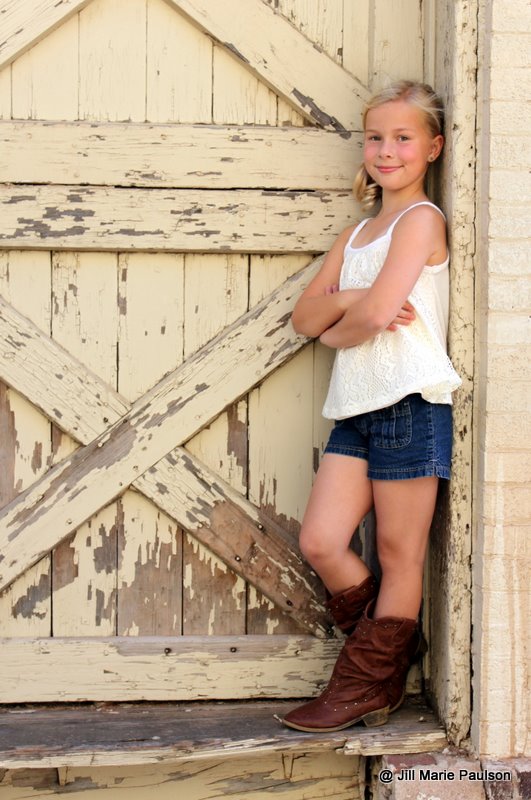
We found this white brick in an alley a couple blocks down the street from the red brick. Gives a much 'cooler' feel to the photo, but just love her sweet little smile in these two.


Here's some grey tile we found at a downtown storefront...a little sweet...

A little mischevious...

A little toothy...

All adorable. But, wait...I might be a little biased!

Monday, May 26, 2008

Happy Memorial Day!

As planned, Justin, Kaitlin & I went on a day trip with my parents and sister Lynn. We headed towards Ashfall Fossil Beds in Nebraska and before going in to check out the displays, we had a picnic lunch.

The weather was less than idea - quite chilly and very windy. It was a 'hold on to your plates' type lunch.

The fossil beds were quite interesting. I didn't even know that this park was there, but there are fossils millions of years old. This picture was taken inside the Rhino Barn.

On the way back home, we went for a drive through Ni0brara State Park and for a bit of a nature walk down to a railroad bridge.


Once we got back to my parent's house, we took a couple shots in front of their lilac bushes.

It was a fun day and a great drive in the country...hope you had a great Memorial Day!

Thursday, May 22, 2008

Photo Shoot: Red Wall

I realized the other day that it's been a VERY LONG TIME since I've shared some 'photo shoot' type photos of Kaitlin...probably because the weather has just been so crappy for so long that it was keeping us inside and I just don't like indoor photos as much.

However, a few weeks ago we braved a windy, chilly day and went out for a shoot. We went downtown and scoped out a few locations.

This was my favorite...love the deep red brick.


This was actually the very first shot of the shoot...guess she had to get her goofiness out of the way right off the back, so she could give me a few good smiles. Love it!

Have a few more favorites from the outing I'll be sharing in separate posts. Stay tuned.

Tuesday, May 20, 2008

Reader Question: Rule of Thirds

I recently received a question from a reader in response to my 8 Tips to Better Photo Composition that I wanted to address.

Jill - This is a great article! Thanks! I have one more question - it may be kind of silly, but how does the rule of thirds apply to close ups of people? I was trying to take a look at the witch photo to see how it would apply. I was also looking at the one of your little girl on the steps in the pink coat to see how it could apply here as well? Any help would be great! Becky
Thanks for the great question, Becky!

As for the first part of your question, it is still a good idea to implement the rule of thirds when taking close ups of people. The eyes are key to any good portrait, regardless if your subject is looking at the camera or not. Generally, the trick with portraits is to get the eyes on or slightly above the upper third line. So, in the witch photo referenced (below), I placed my daughter's beautiful little lashes near that upper third line.

As for the second part of your question, Becky, the rule of thirds is also utilized in the pink coat photo below even though I was using it as an example for the vary your angle tip. Now this is a full-length shot, so the most important thing here is the subjects face. If you drew those imaginary rule of thirds lines on the photo you would see that my daughter's face is quite near the upper-right intersection. It might not be exact, but it doesn't have to be exact to get the effect. Also, you would also see that her eyes are again on or slightly above the upper third line.

Side note on the rule of thirds: The rule of thirds is just one of many very effective composition techniques. The techniques that I mentioned in my article can be used individually, in conjunction with other tips, or not at all...sometimes rules are meant to be broken. So, don't get too caught up in always trying to incorporate certain techniques in every photo you take. Allow yourself to experiment and create some new techniques of your own - you might like the results!

Happy snapping!

Stay tuned for an upcoming article on lighting tips!!
Thursday, May 1, 2008

8 Tips to Better Photo Composition

The International Scrapbooking Association May Newsletter issue went was published today. Like last month, I contributed a photography article to the newsletter.

8 Tips to Better Photo Composition
A huge part of creating a successful scrapbook layout is the photos you choose to use on that page. That’s why photography has become a secondary hobby to most scrapbookers. Last month, I shared with you several tips to improve your photography skills by simply getting to know your camera. This month, we’ll focus on improving your shots through eight composition tricks.

#1 - Use the Rule of Thirds
You’ve probably heard of this principle in reference to designing a scrapbook page (and it’s a great one to follow), but the concept actually began with photography. Imagine a grid, like the one below, dividing your photo. The idea is to have the key elements of your photo off-center and on the lines or, even better, on the intersecting points of the grid…it makes for a much more visually appealing picture.


#2 - Use Leading Lines
You can use many things to create leading lines in your photographs – a road, fence, river…even an airplane wing. If used correctly, these lines help to draw the viewer into the picture and toward the subject. They can also help to create depth in a photo and are often most effective if the leading line begins in a corner of your photo.

#3 - Watch Your Background
We’ve all taken them…the shots of a loved one with a light post sticking out of their head or where the beloved subject is overwhelmed by the clutter of your untidy living room (or maybe that’s just my problem). Try to be always aware of the background when taking photos as these types of problems can generally be easily solved by moving your subject or changing your angle (see #8).

#4 - Fill the Frame
AKA – Get Close…no closer! Whether you do this by physically moving closer to your subject or utilizing a zoom lens, filling the entire frame with your subject can have a stunning effect and allow you to pick up details that would be missed in a full-length shot. Although much of my daughter’s witch costume is not visible in this shot, it is still my favorite from the shoot. There’s enough to get the idea…and just look at those lashes!!
#5 - Frame Your Subject
A fun way to draw attention to your subject is to frame them in a window, doorway, or even elements in nature. In the shot below, my daughter is framed by the overhanging trees. Since I was going for somewhat whimsical, distant look in this photo, she is rather small, so I also used the rule of thirds to help draw the viewer’s eye to her in the photograph.

#6 - Don’t Amputate
When going for a full-length shot, don’t cut someone off at the ankle (or worse yet, the neck)! Always be aware of what you are ‘cutting off’ in your photos and where. Of course, when taken a closer photo, you have to cut of something, right? Of course. The general rule of thumb is to not cut your subject off at a joint, which makes them look unnatural (as if they’ve been amputated). It’s generally best to crop between joints.

#7 - Vary your angle
Any angle can get a little boring if you use it all the time…switch things up a bit by varying the angle from which you take your photos. Try taking shots from above your subject, while lying on the ground, at eye level, or from the side. I shot this picture of my daughter from above and not only is it an interesting angle, but also allowed me to highlight her beautiful dress in a way that no other angle would have. This can also mean varying the angle of your camera itself and giving your photo a tilted effect as in the second example below.


#8 - Go vertical
Just because your camera is built in a horizontal orientation doesn’t mean you can put it on its side and go vertical. Vertical shots can work very well when taking portraits and can really add interest to a shot of something that is generally viewed in a horizontal nature, such as this picture of a quilted American flag that I took at the Air & Space museum in Ashland, NE.

What did I miss? What are your favorite tricks and tips for better photo composition?

Saturday, April 12, 2008

The Wakefield Mysteries

Last Saturday, Kaitlin and I attended an outdoor theatre event. It was a very unique performance and the first of its kind every presented at the College where I work - it is called The Wakefield Mysteries.

Basically, there were four different points along the College's main road where audience members could sit and the various scenes where performed on wagons that moved from point to point. There were 5 scenes and the production included over 90 cast and crew members.

The first scene was Hail Mary in which God chooses Mary to be the mother of Jesus.

Joseph didn't take the news so well, but he got over it. What a guy...

Scene two was A Baby Raises a Ruckus, the traditional nativity scene.

Scene three was Miracle and Revolt. Her Jesus bring Lazarus back to life.

Here Pontius Pilate decides the fate of Jesus.

Scene four, Torture and Crucifixion, was certainly the most moving scene...and graphic.


In scene five, An Empty Tomb - Victory, Jesus rises again and reveals himself to his mother.

It was different watching a play in which each scene brought different actors playing the same characters, but it was also very intriguing. From my work at the College, I knew a vast majority of the people involved and was wonderful to see them perform in this play. I was amazed by many of their portrayals!

There had been much anticipation about this play not only for the theme and nature of the play, but also the weather. Let's just say that we had not been great in the days before the play...including a snow storm bad enough to close the College and the local school district just the Monday before.

Over the course of the week, the temperature slowing inched up each day - just enough to melt the newly fallen snow and dry things out a bit. The day of the play was about 60 degrees and sunny. A little windy, but overall, pretty decent considering.

Every day since has been some combination of cold, cloudy, rainy, and snowy.

Hmmm...sounds to me like the prayers for good weather from the cast and crew prevailed...

Thursday, April 10, 2008

Five photography books on my Amazon wishlist...

As a result of having a child and obtaining this obsession with scrapbooking, a natural result (at least I tell myself it's natural) is that I have a growing interest in improving my photography.

I have read several photography-related books in the past couple of years, yet, somehow, my Amazon.com wishlist keeps getting longer instead of shorter!!

Here are 5 photography books currently on my wishlist:

  1. Understanding Exposure: How to Shoot Great Photographs with a Film or Digital Camera by Bryan Peterson - Exposure is something I can definitely say that have do not really have a good handle on...I usually just let my camera choose, so I'd like to learn more and from what I've heard, this book is a great guide.
  2. Professional Children's Portrait Photography: Techniques and Images from Master Photographers by Lou Jacobs - "Blending advice with example images, this guidebook marshals the wisdom and experience of 15 seasoned professionals to present a comprehensive resource on one of the most challenging subfields in the portrait-photography genre." (taken from Amazon.com book description) All I know is that photographing Kaitlin can certainly be challenging sometimes and any pro tips would be great!
  3. Complete Digital Photography, Fourth Edition by Ben Long - I've been shooting digital for quite some time, but I have been letting my camera do most the work. From the description and reviews, I am hoping that this book could help me to step over into the manual world a little more comfortably.
  4. Capture the Portrait: How to Create Great Digital Photos by Jenni Bidner - This book isn't even released yet, but I liked the cover (yes, I tend to be a cover judger...sorry), so I'll be watching Amazon for more details in the future.
  5. The Moment It Clicks: Photography secrets from one of the world's top shooters by Joe McNally - "The first book with one foot on the coffee table, and one foot in the classroom." (taken from Amazon.com book description) What can I say...I LOVE book with pretty pictures. It also helps that this book comes highly recommended by Scott Kelby, whose books I love.
If any of you have or have read any of these books, I would love to hear your opinion on them. Should they stay on my wishlist? Do you have others that you would recommend in addition to these or instead of any the above listed books??

Here are a few photography-related books I have reviewed on this blog in the past:

  1. The Digital Photography Book by Scott Kelby

  2. Photo Idea Index by Jim Krause

  3. Expressions: Taking Extraordinary Photos for Your Scrapbooks and Memory Art by Allison Tyler Jones

Here are a couple photography-related books that I have on my book shelf from before my reviewing days:

  1. Photographing Children and Babies: How to Take Great Pictures by Michal Heron

  2. Creating Keepsakes: Photography for Scrapbookers by Tracy White

Note on Amazon.com preorders: You might have noticed that I listed a book above that isn't even available yet and wanted to make sure that you were aware of one VERY neat feature at Amazon.com. Another way to save even more money by buying your books through Amazon.com is to PREORDER your books through Amazon.com. On most preorder books, you will see a "Special Offers Available" link just below the price info. The special offer is that if you preorder the book, you will receive an additional 5% off at checkout. Also, if the Amazon.com price decreases between your order time and release date, you'll receive the lowest price as well as the 5% pre-order discount. Pretty good deal, I'd say!

Monday, April 7, 2008

How to Get the Most Out of Your Point and Shoot Camera

My first article was published in the International Scrapbooking Association April Newsletter that went out the other day. It was pretty exciting for me to see it in print so I thought that I would share it here as well.


How to Get the Most Out of Your Point and Shoot Camera

I use a point-and-shoot camera. There…I said it. I’m not ashamed. I’ve gotten some darn good pictures out of my Canon S3IS over the past couple of years if I do say so myself (and, obviously, I do). Not to say that I’ll never upgrade to a DSLR (I’m actually saving my pennies now…), but if there is one thing I have learned about
photography in the last 6 years of scrapbooking, it’s that creating great photos has much more to do with technique then equipment.

In this article, I plan to share 6 tips to help you get the most out of your point and shoot camera.

#1 – Read the Manual
Not the most engaging reading, I know. But honestly, you’ll never know how much your little point and shoot can really do if you don’t read the manual.

#2 – Nix the Date Stamp
This is the first thing you should learn how to do from that manual! There is nothing that can ruin a great shot faster than a glaring orange (or whatever color it might be) date stamp in the corner. The information is still stored in the EXIF data, so it is not lost. Also, most processors include that information on the back of you printed
pictures.

#3 – Optical Zoom Good…Digital Zoom BAD
The next thing you should learn how to do is make sure that the optical zoom is turned on and the digital zoom is turned OFF. Optical zoom uses the lens of the camera to bring your subject closer, which is what you want. On the other hand, digital zoom causes the camera to ‘crop’ your image inside the camera, which decreases image quality and is NOT what you want.

#4 - Bigger is Better…
…with image file size, that is. Although it will mean that you will be able to fit fewer photos on your memory card, it is always best to set your camera for the highest possible resolution (usually termed as ‘L’ or ‘Large’) and lowest compression (usually termed as ‘Fine’ or ‘Superfine’). This will give you the highest quality image possible for your camera and allow you the more
post-processing freedom.

#5 - Lock the Focus
This may seem basic, but I’ve been surprised how many people have no idea what I’m even talking about and it can make a world of difference in your photos. Basically, most cameras now have the ability to depress the shoot button half way without taking a picture to allow the cameras auto focus feature time to find and lock the focus. Once it’s locked, snap your picture and you’re much more likely to have a focused image.

#6 - Use the Preset Modes
It’s not cheating…really, it’s not. That’s why the camera manufacturers put them there. Not all of us have the time (or desire) to learn every nook and cranny of manual photography, but that doesn’t mean we can’t have great pictures anyway!! Most cameras these days come with at least the basics such as action, landscape, macro, night, and portrait and generally they work wonders. My camera also has a fireworks mode which I used for this picture that I can guarantee you I wouldn’t have been able to achieve this result in manual.

I hope you will now take some time to get to know your camera a little better and unlock its potential. Please stay tuned for more great tips in our next newsletter when we take a look at how to improve your photos through composition techniques.

There are several other great articles and some layout inspiration in the newsletter as well. You can check out the full edition here. ISA is truly a great community of scrapbookers from across the globe and I have really been enjoying my involvement there as a VIP Team member over the past couple of months! If you're not familiar, I hope you come and visit us soon!